
Sparring builds calm, not fights.
The short version
- Sparring is controlled practice with a partner, in protective gear, run by a black belt instructor. It starts at green belt, never before.
- It’s where kids learn to stay calm and keep thinking while someone’s moving at them. That’s the skill self-defence actually runs on.
- Research on martial arts training points the same way: better self-control and attention. Neither of the two big research reviews found it makes kids more aggressive, and one found it lowers aggression.
“Sparring isn’t about winning a fight. It’s about learning to think under pressure, control your body when adrenaline is high, and respect your partner enough to keep them safe. If a student leaves sparring scared or hurt, we failed, not them.”
Endurance teaching philosophy
What sparring is (and what it isn’t)
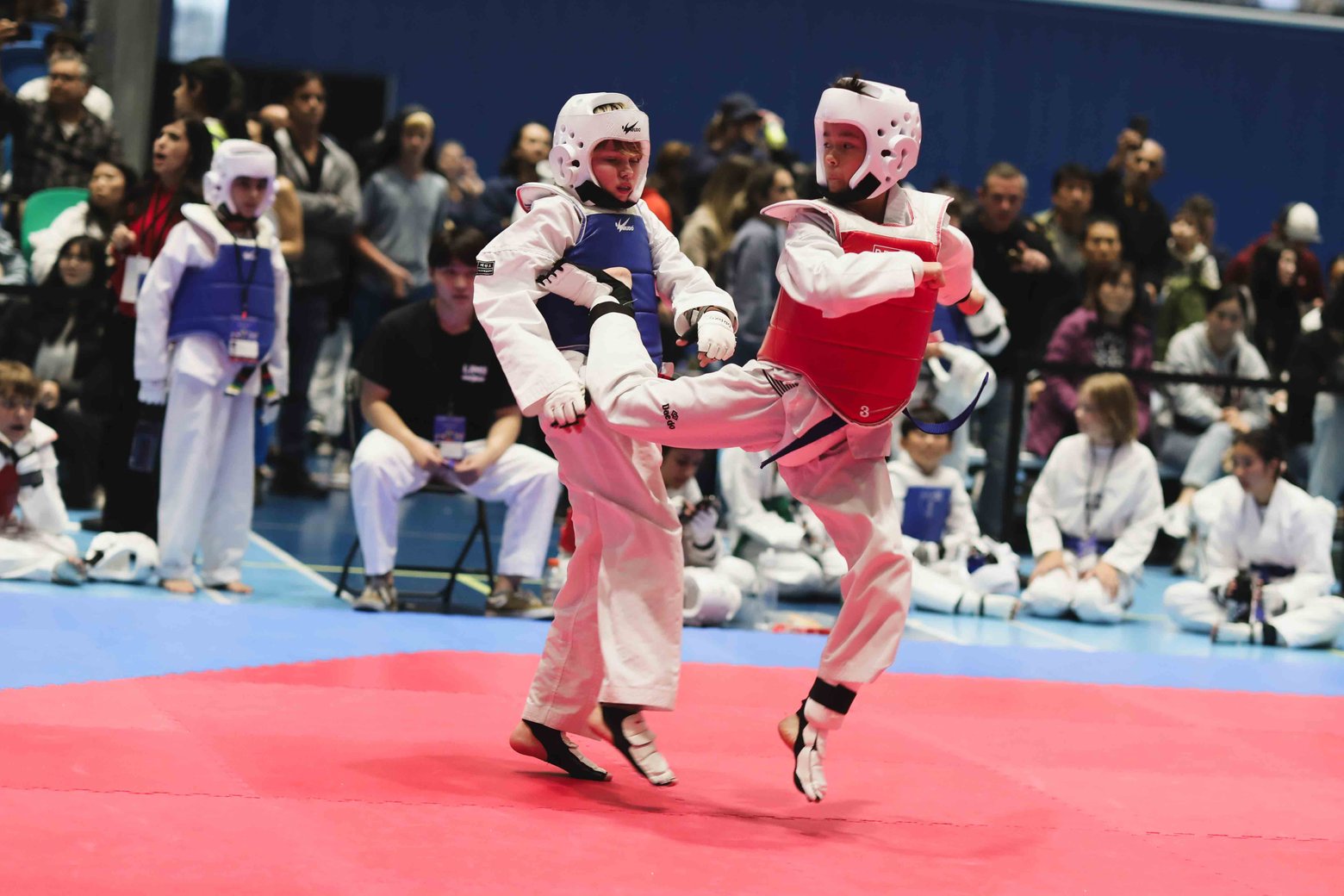
Sparring is practice, not a fight. Two students, paired by size and skill, use the kicks and blocks they’ve learned against a partner who’s moving and thinking too. There are rules, there’s gear, and an instructor can stop it with one word.
It isn’t a free-for-all, and it isn’t a tournament. Most class time goes to structured drills. Free sparring is the reward, not the default.
Why we do it
1. A pad doesn’t hit back.
Kicking a pad teaches the move. A partner teaches when to use it, and what to do when the plan falls apart. Real moments don’t hold still, so practice can’t either.
2. Calm is a skill, and it’s trained in small doses.
The first time a kid faces a partner, their heart rate jumps. That’s normal. Round by round, the same pressure stops feeling big.
Psychologists have a name for this. Donald Meichenbaum called it stress inoculation: you build tolerance to pressure the way a vaccine builds immunity, with a small, controlled dose. Sparring is that dose. Real enough to count, safe enough to repeat.
The payoff shows up far from the mat. A kid who’s learned to breathe and think while someone’s coming at them brings that same calm to a hard test, a tryout, or a tough day at school.
3. Self-control gets stronger, and researchers have measured it.
- 207 kids, Taekwondo vs. gym class. Children from kindergarten to Grade 5 who took Taekwondo improved more than classmates in regular PE on self-control, behaviour in class, getting along with others, and even a mental math test (Lakes and Hoyt, 2004).
- A randomized trial with 240 kids. Children aged 7 to 11 took an 11-week beginner Taekwondo course. Teachers reported fewer behaviour problems and better attention, and the kids did better on a lab test of focus (Ng-Knight and colleagues, 2022). Not every measure moved. That’s exactly why we trust it.
- The big picture. A review in the journal Science lists martial arts among the activities shown to improve children’s executive functions: focus, self-control and planning, the skills that run everything else (Diamond and Lee, 2011).
These studies looked at Taekwondo training as a whole, not sparring alone. Sparring is where those skills get tested hardest.
4. It doesn’t make kids aggressive.
It’s the question parents ask most, and it’s a fair one. Two research reviews have pulled the studies together:
- A 2017 review of 12 studies, covering 507 kids and teens aged 6 to 18, found martial arts training reduced aggression by a medium amount (Harwood, Lavidor and Rassovsky).
- A 2020 review of 14 studies found a small, real boost to wellbeing, and no meaningful change in aggression either way (Moore, Dudley and Woodcock).
So here’s the honest summary: martial arts training lowers aggression or leaves it where it was. Neither review found it raises it. In an interview after his study, Harwood pointed to the traditional martial arts, where respect and control are taught alongside technique, as the most helpful. That’s our rule too: character first, skills second, belts third. It’s also why a student who’s upset or frustrated sits out, cools down, and only then goes back in.
5. Self-defence needs a moving partner.
Self-defence that’s only ever been practised on someone standing still tends to fall apart against a real person. Sparring is where timing, distance and a cool head come together. The goal of self-defence is getting away safely. Sparring makes sure a kid who has to defend themselves doesn’t freeze.
How it builds, belt by belt
- Little Ninjas and Tigers (ages 4 to 7): no sparring. Pad work and partner coordination drills.
- White to orange belt: no contact sparring. Footwork, distance and one technique at a time, with pads and cooperative partner drills.
- Green to red belt: light-contact sparring begins, in short rounds of one to two minutes. The instructor sets the contact level before every round. No head kicks. Gear: forearm, shin, hand and foot protectors.
- Brown belt and black stripe: moderate contact, full gear. Still no head kicks.
- Black belt: head kicks allowed, with control.
How we keep it safe
Here’s what the injury research actually says, and what we do about it.
- Class isn’t competition. In a 12-month study of 285 elite taekwondo athletes in Korea, injuries per 1,000 practices or matches were about five times higher in competition (24.86) than in practice (4.79) (Son and colleagues, 2020). Our classes are practice. Competition is optional.
- Distance and blocking first. A study of three junior tournaments with more than 4,000 kids found most injuries came from kicks that weren’t blocked. The researchers’ advice: teach blocking, and keep head contact out of kids’ competition (Pieter and Zemper, 1997). We go further: every student spends white to orange belt on footwork, distance and defence before anyone spars, and head kicks wait until black belt.
- No gear, no sparring. No exceptions.
- Our non-negotiables, every round: the instructor sets the contact level before the round starts. When the instructor calls stop, both students stop. Partners are paired by size and skill, and a senior student paired with a beginner keeps it light (that’s a leadership test). No punches to the face, at any level. A student who’s upset or frustrated sits out and cools down first.
The Olympic piece
Sparring is the part of Taekwondo the world watches. It’s been an Olympic medal sport since Sydney 2000. Most of our students will never compete, and that’s fine. The skills are the point.
Questions parents ask
Does my child have to spar?
Sparring starts at green belt and it’s part of training from there. It’s never graded at a colour belt test, and nobody’s pushed in before they’re ready. A student who needs more time keeps drilling with an instructor until they are.
When do they start?
At green belt. Little Ninjas and Tigers (ages 4 to 7) don’t spar at all.
What gear do we need?
Green to red belt: forearm, shin, hand and foot protectors. Brown belt and up adds a head guard, mouthguard, chest protector and groin guard. Ask your school for the current gear package.
Does my child have to compete?
No. Tournaments and Sparring Club are there for students who want them.
Try it
Every black belt started with one class. Your child’s first class, Taekwondo 101, is free.
Taekwondo classes in Port Moody, Burnaby and Port Coquitlam.