By Master Milad
The short answer
Yes, but most of it isn’t punching. Real self-defence for a young martial artist is mostly choices: where they go, who they’re with, and when they speak up. We teach it as the six A’s, and what each martial artist practises depends on their age and level. The physical part is real, and it’s for real danger only.
The six A’s
People ask me which comes first, awareness or avoidance. Awareness. You can’t avoid something you never noticed.
- Awareness. Notice where you are, who’s around, and what feels off.
- Avoidance. Most trouble is avoidable. Your choices shape how the world treats you: what time you go out, which parts of town you go to, what you do, and most of all who your friends are.
- Adrenal control. Breathe. A calm martial artist thinks clearly. A panicked one freezes.
- Assertive communication. Eye contact, strong voice, clear words: “Stop. Leave me alone.”
- Action. When words don’t work and you’re in real danger, you move.
- Adjustment. If something doesn’t work, try something else. Plan A doesn’t work? Plan B. Plan B doesn’t work? Plan C. There are many ways to protect yourself. Keep the goal in mind, keep your cool and don’t give up. That’s indomitable spirit.
The rule of two
Young martial artists should never be out on the street alone. Two or more, always. It’s the simplest protection there is, and it works.
Strangers aren’t good or bad. They’re strangers.
A stranger is just someone you don’t know. Most strangers are good people. Every parent in our lobby is a stranger to somebody else’s child.
But a small number aren’t good, and they know how to trick young people. Here’s the rule we teach: an adult you don’t know has no reason to want to talk with you, hang out with you or give you things without your parents’ OK. Adults know a young martial artist almost always has a grown-up nearby (a parent, a teacher, a nanny). So when a stranger skips that grown-up and comes straight to you, be careful.
And you never, ever leave with a stranger.
If someone tries to take you
This is the one time the rules change. If someone tries to take you, you do everything you can not to go. Scream. Grab onto something and hold on. Go dead weight (drop and make yourself heavy). Break the grip any way you can. Go for the eyes. If one thing doesn’t work, try the next. That’s Adjustment.
The goal is simple: don’t let them move you somewhere else. Nobody’s tough with a thumb in their eye.
It rarely happens. But martial artists who’ve practised it don’t freeze.
One hard line: none of this is for the playground. Eye strikes are for real danger, like an adult trying to take you. They’re never for a classmate.
If you get lost
Stay close to a grown-up. Don’t wander off. Being silly or sneaky in a busy place can turn serious fast.
Every martial artist should know a parent’s phone number by heart. Start small: the last four digits, then the whole thing.
Grown-ups are part of the plan
Watching our martial artists is the job. At the park, phones go away. We get it, parents are stretched thin. But you’re the biggest part of your child’s safety, and they need to see you watching.
Watching doesn’t mean hovering, though. Martial artists also need room to learn, and that’s where the bullying conversation starts. Does taekwondo help with bullying?
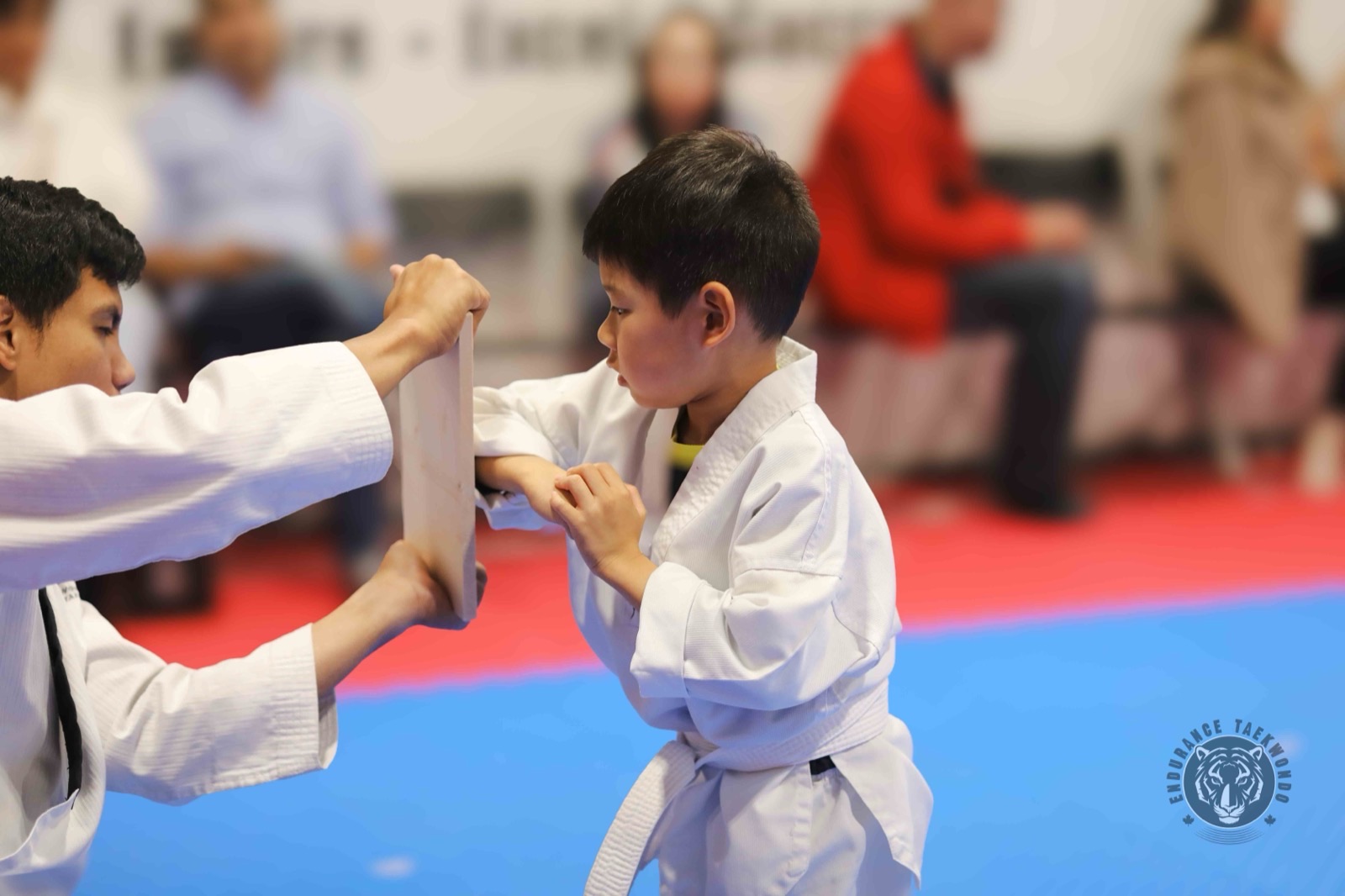
What self-defence looks like at each level
Kindness comes first at every level. A martial artist who’s kind makes friends, and friends are the best protection there is.
- Little Ninjas (ages 4 to 6): kindness, stranger safety, staying close, knowing their phone number.
- Beginners: handling bullies with words first, while building the skill to protect themselves if it ever gets physical. Someone grabs you, pulls your hair, shoves you, spits on you. Young martial artists deal with some wild stuff, and they should know what to do.
- Intermediate martial artists (in gear): blocking, footwork and head movement.
- Advanced martial artists: getting back up from the ground and staying calm under pressure. At black belt, joint locks and chokes.
- Teens and adults: knife and weapon defence, and what to do against more than one attacker.
The weapons are plastic, and the training is controlled. Nobody gets hurt learning this.
Who teaches it
Our black belt head instructors and senior instructors run every one of these classes. One of them is Master Vieng, a 7th degree black belt in taekwondo and a 3rd degree black belt in Brazilian jiu-jitsu, with over 40 years in martial arts. Your martial artist is in good hands.
Character first, skill second, belts third. Self-defence follows the same order.

About the author. Master Milad Bahrami opened Endurance in Port Moody in 2014, and today it’s three schools: Port Moody, Burnaby and Port Coquitlam. Read his story
Tap if this one landed.