By Master Milad
The short answer
- Patterns (poomsae, in Korean) are set routines of blocks, strikes and kicks, done the same way every time.
- Competition patterns take a kid’s routine from sloppy to refined and put it in front of judges.
- Your kid builds memory, coordination and calm under pressure, with zero contact.
- Your first class with us is free. Book it
What’s a pattern?
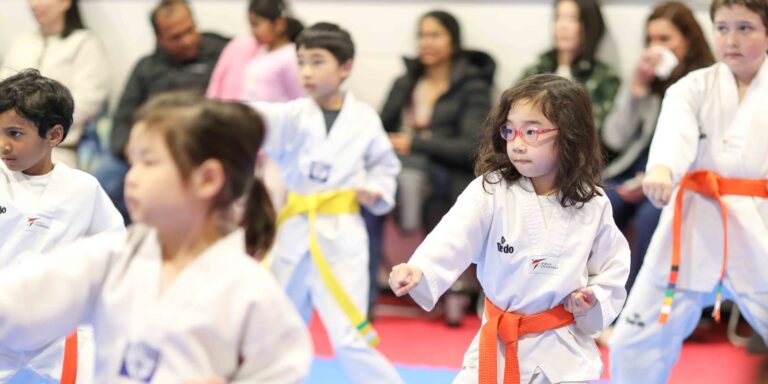
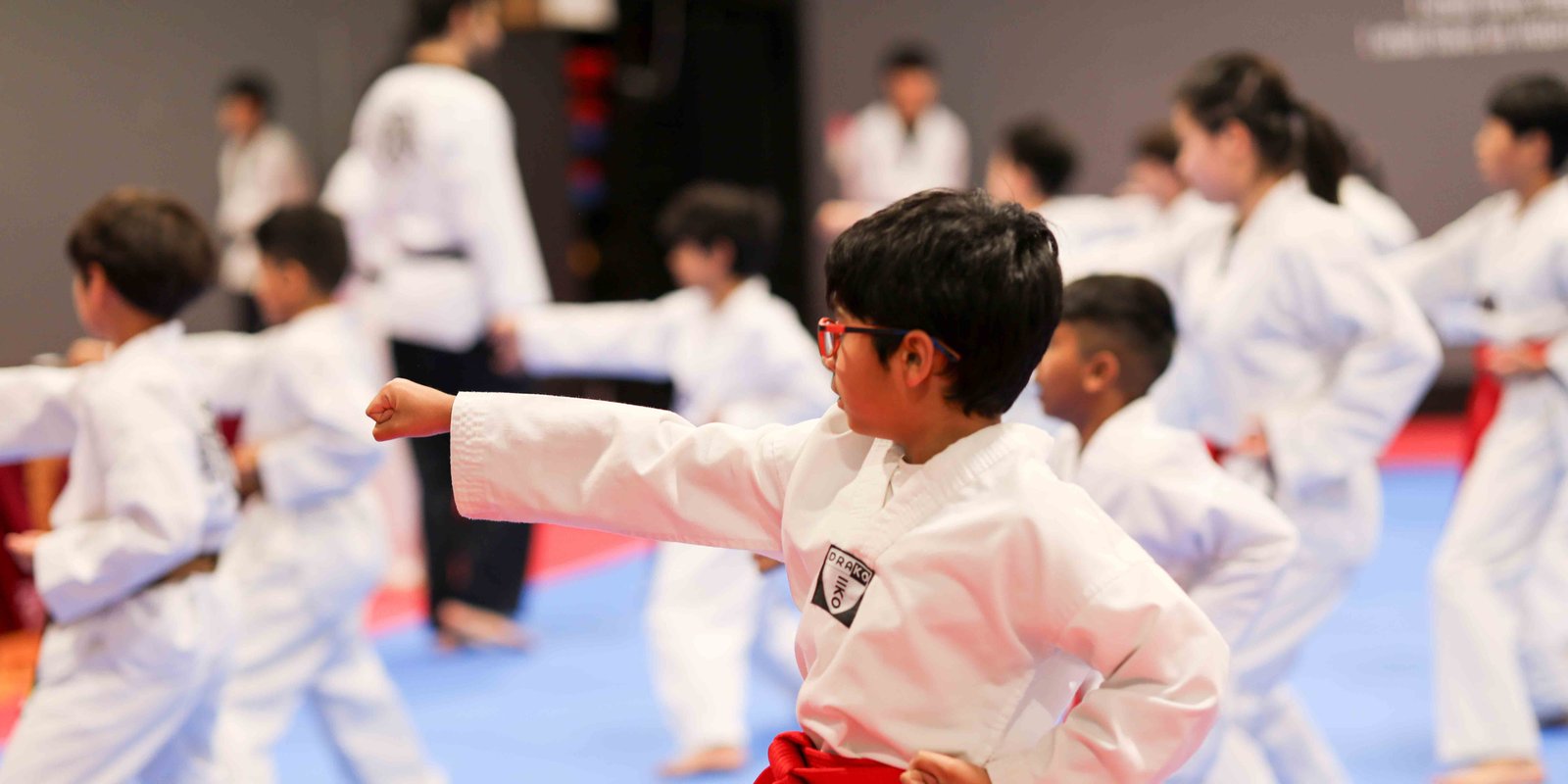
It’s choreography. A fixed sequence of stances, blocks, strikes and kicks, done in the same order every single time. Your kid performs it at a belt test in front of a master, or at a tournament in front of judges for a medal.
Nobody gets hit. It’s technical and artistic expression. Precision, power, breathing, rhythm. Think figure skating, not boxing.
The same pattern in Metro Vancouver and in Seoul
Taekwondo patterns are unified. Kids all over the world learn the same ones, set by Kukkiwon, the world headquarters of taekwondo, and used in World Taekwondo competition.
It didn’t use to be that way. Every school had its own version of the colour belt and black belt patterns, and a lot of schools had their own white belt pattern too. Now the standard’s the same everywhere. A kid from Burnaby can step onto a mat in Madrid and do the exact same form as the kid beside them.
I don’t know of another martial art whose patterns are done this widely, to one standard. And honestly? I think they’re some of the most beautiful forms there are.
What does “Taegeuk” mean?
The colour belt patterns are called Taegeuk. The word means “supreme ultimate,” and its symbol is the red and blue circle in the middle of the Korean flag: eum and yang, or yin and yang as most people know it. Opposites in balance. Il jang means “first chapter.” So Taegeuk Il Jang is, roughly, the first pattern of balance. Pretty good name for a kid’s first form.
Before Taegeuk, our white belts learn one more: the “I” Pattern, named for its shape. Here’s our white belt pattern, filmed at our school. Every pattern after it is in the same playlist on our YouTube channel.
What it does for your kid
Memory that lives in the body. This isn’t memorizing a list. It’s muscle memory. Researchers describe three stages of learning a physical skill: thinking about every move, cleaning it up, then doing it without thinking (Fitts and Posner, 1967). That’s the road from sloppy to refined. Rep it enough and it becomes second nature.
Coordination and balance. Patterns are full of turns, pivots and moments on one foot. In a randomized trial at Hong Kong Polytechnic University, children with developmental coordination disorder trained taekwondo for three months, and their standing balance improved compared with kids who didn’t train (Fong and colleagues, 2012 and 2013).
Focus and self-control. In a study of 207 kids from kindergarten to Grade 5, the ones randomly assigned to traditional taekwondo improved more in self-regulation than kids in regular PE (Lakes and Hoyt, 2004). Self-regulation means managing your own attention, emotions and behaviour.
Handling pressure. A pattern takes about a minute. Everyone’s watching. You get one shot. Athletes who practise under pressure hold up when the pressure is real (Oudejans and Pijpers, 2009). A belt test is practice pressure. A tournament is the real thing.
Why patterns feel hard (and why that’s the point)
For a lot of kids, patterns are the toughest part of the curriculum. It’s a different pace from kicking drills: slower, more exact, more to remember. It’s often the part of a belt test that makes them most nervous.
Here’s what I’ve seen for almost 30 years. Kids like what they’re good at. Patterns start to feel fun right around the time they get good at them. A class or two a week usually isn’t enough reps to get there, so the kids who practise at home get there first. Competition patterns training gives them the extra reps.
Great for kids who don’t love contact
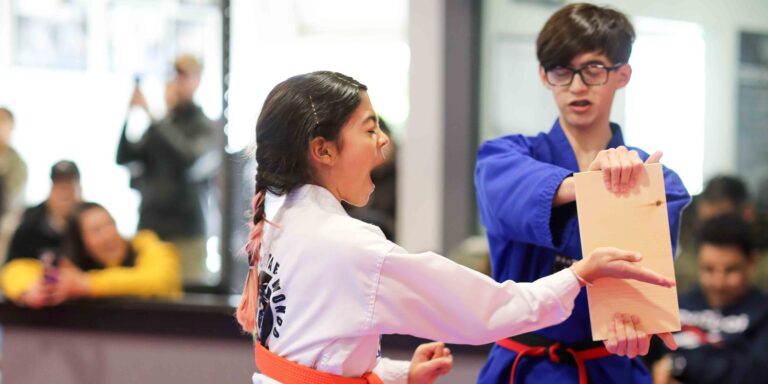
Not every kid wants to spar, and that’s fine. Patterns let them compete, earn medals and feel the nerves of a big moment without anyone hitting them. If your kid is curious about contact, here’s why sparring builds courage.
Nerves are part of it
Plenty of kids love patterns and still dread tournament day.
They don’t sleep the night before. Their stomach hurts. That’s normal, and it’s exactly what good coaching is for: a plan, practice rounds and a coach in their corner.
And judges get it wrong sometimes, in patterns and in sparring. Every competitor eventually loses a call they thought they’d won. The kids who shake hands and get back to work keep improving. That’s part of competing.
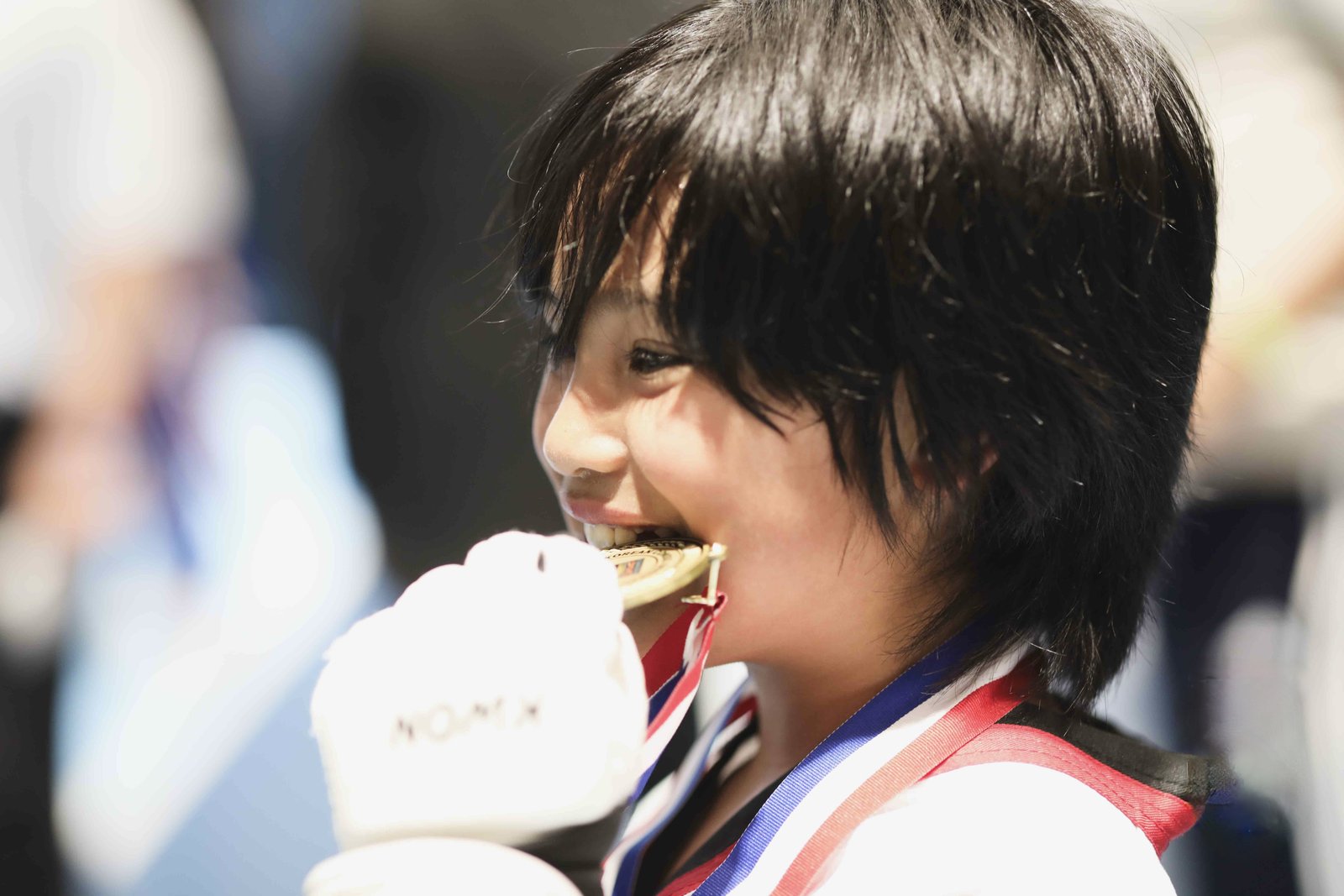
It was never really about the medal. It’s about having the courage to step out of your comfort zone and compete.
From sloppy to sharp
I’ve seen it with black belts whose patterns were the weakest part of their first-degree test. Before their second-degree test, the ones who ask for help do privates, build their creative pattern (one they choreograph themselves), and practise it over and over.
Their next test looks completely different. Same kid, same talent. The difference was preparation.
Why I want your kid to compete
Life is a competition. It doesn’t get easier as kids get older. It asks more of them.
Kids who train and compete at something physically hard when they’re young build the body, mind and spirit for whatever comes next. And they’ll have coaches in their corner.
It’s growing fast
Today, serious athletes pick patterns or sparring and specialize. Poomsae became a medal event at the Asian Games for the first time in 2018, in Jakarta. It’s one of the fastest-growing corners of kids martial arts, especially for kids who love precision more than contact.
Who should join competition patterns?
Students who want to master their patterns and compete at regional, national and international events. It’s extra training on precision, power, breathing and rhythm. Your child joins once an instructor says they’re ready.
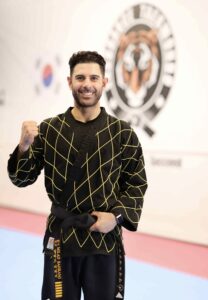
About the author. Master Milad Bahrami opened Endurance in Port Moody in 2014, and today it’s three schools: Port Moody, Burnaby and Port Coquitlam. Read his story
Tap if this one landed.